Philip II Augustus
The DecameronPhilip II Augustus is the King of France whose sudden desire for the Marchioness of Monferrato is checked by her composure and wit. His brief visit turns a royal courtship into a test of whether rank and opportunity can overcome a woman’s resolve—and ends with his prompt departure rather than coercion.
Identity and Background
The story identifies Philip by the epithet Philippe le Borgne, which its accompanying note explains as a reference to Philip II of France, better known as Philip Augustus. He is preparing to leave France for a general Christian crusade, with his forces sent ahead, when the conversation at court turns to the virtues of the Marquis of Monferrato and his wife. A gentleman praises the Marquis as renowned among knights for every virtue and the Marchioness as the fairest and noblest lady in the world.
Philip has not seen the Marchioness. Nevertheless, the praise takes hold of him so powerfully that he falls ardently in love and resolves to arrange his journey so he can visit her. The narrative thus presents his desire as founded on reputation and imagination, not on any prior relationship between them.
The Visit and the Hen Banquet
Because the Marquis is away on crusade, Philip sees an opportunity to approach his wife. He chooses to travel by land to Genoa, where he intends to embark, so that he can make an ostensibly honourable visit along the way. He sends his main force forward, travels with only a few gentlemen, and dispatches a courier to tell the Marchioness to expect him for dinner the next morning.
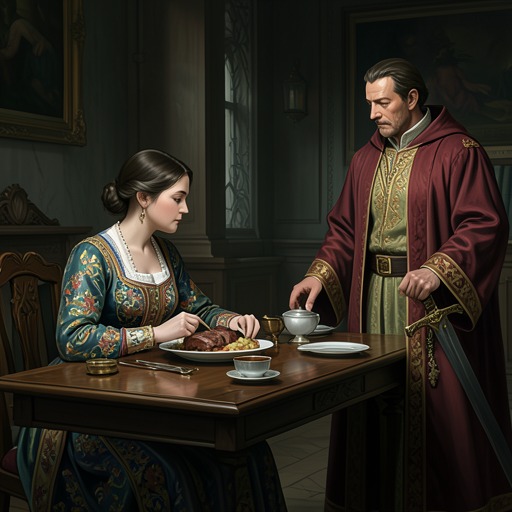
The Marchioness welcomes the King graciously, but understands why he has come. She consults the gentlemen remaining there about preparations for his reception, while reserving the meal and its dishes to herself. She gathers all the hens available in the country and has her cooks prepare a succession of different dishes from them alone. The varied courses disguise a single pointed choice: despite the abundance of game in the region and the notice she received in advance, the royal table offers only hens.
As the meal proceeds, Philip notices the repetition. With a merry air, he asks, “Madam, are hens only born in these parts, without ever a cock?” The Marchioness understands the question as more than a comment on dinner. She answers, “Nay, my lord; but women, albeit in apparel and dignities they may differ somewhat from others, are natheless all of the same fashion here as elsewhere.” Her reply turns the banquet’s pattern into an explicit refusal: distinctions of rank do not make women available to a powerful suitor.
Retreat and Narrative Significance
Philip understands both the meaning of the hen banquet and the virtue of the Marchioness’s words. The narrative says he recognizes that further words would be wasted and violence is out of the question. The woman whose beauty first stirred his desire has made her position unmistakable without surrendering the honours due to a royal guest.
He finishes the meal, thanks her for her honourable entertainment, commends her to God, and sets out for Genoa. His swift departure, the story observes, allows him to make amends for the impropriety of his visit. The episode therefore gives his desire a clear limit: his rank and the Marquis’s absence create an opportunity to pursue the Marchioness, but her wit exposes the presumption behind that opportunity, and Philip withdraws.